From a university assignment to a real job-market analysis
One of my recent university projects started with a straightforward question: what skills are companies actually looking for in NLP engineers today?
Instead of relying only on course material or generic lists of “top AI skills,” I wanted to look directly at current job postings and identify the technologies, techniques, and engineering responsibilities that appeared repeatedly.
I turned that research into an interactive web presentation:
NLP Job Market Analysis — Fall 2026
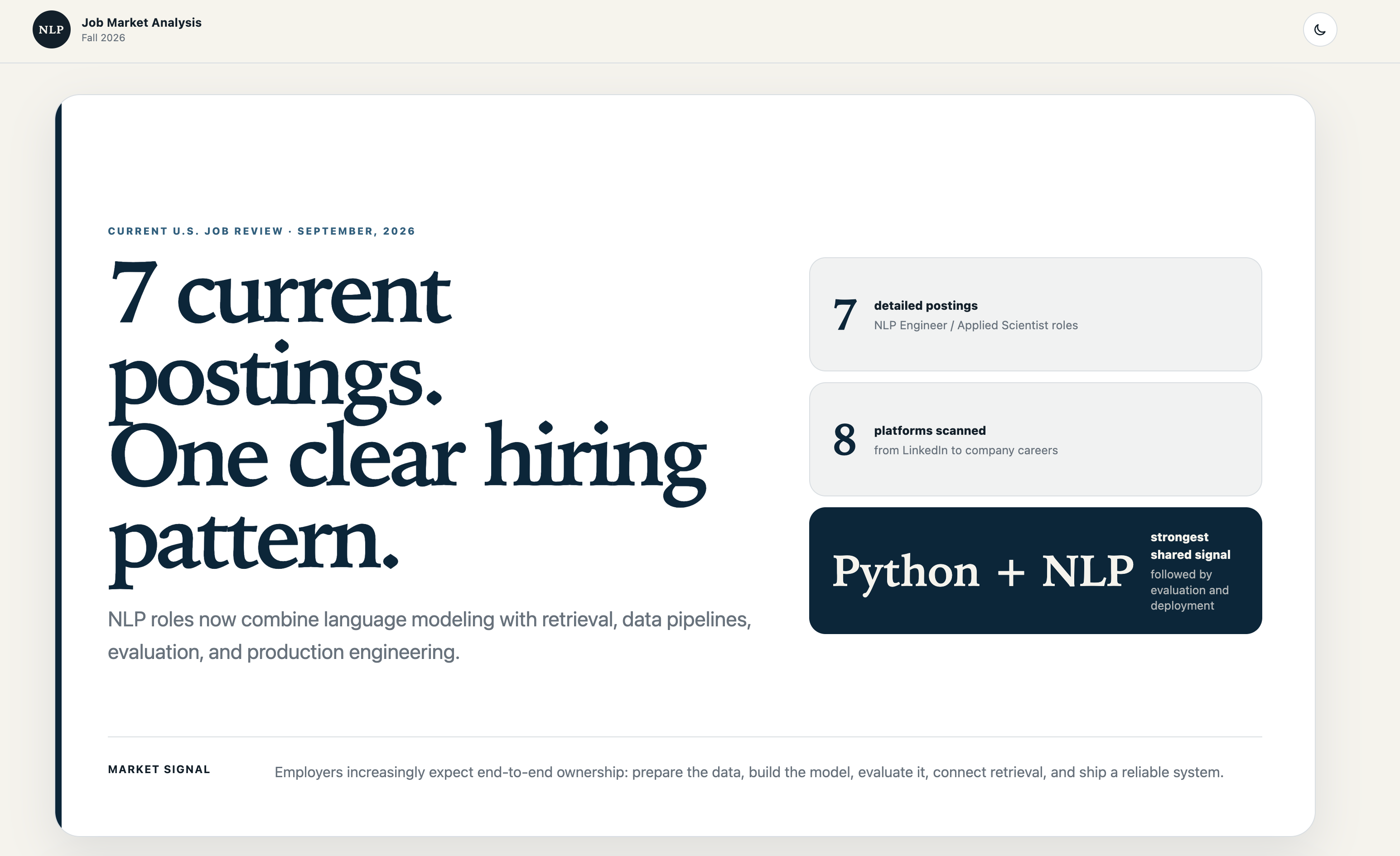
The project reviews current U.S. NLP and Applied Scientist positions and compares them using the same framework: frameworks and libraries, NLP techniques, data processing, programming, deployment, and evaluation.
The final analysis uses seven detailed job postings while drawing from eight job-search sources, including LinkedIn, Indeed, Dice, ZipRecruiter, Glassdoor, Handshake, Wellfound, and company career pages.
The biggest finding: NLP is no longer only about NLP
Before doing this research, it would have been easy to think of an NLP role mainly in terms of text preprocessing, classification, named entity recognition, or transformer models.
Those skills are still important, but the job descriptions showed something broader.
Employers increasingly expect an NLP engineer to understand the entire lifecycle of an AI system.
That means taking raw documents or user queries, preparing and transforming the data, creating embeddings, retrieving relevant information, training or integrating models, evaluating their output, exposing the system through an API, deploying it, and monitoring its performance.
Across the sample, NLP or language understanding appeared in all seven detailed postings. Python or general programming, production ML/deployment, and model evaluation appeared in six out of seven. Transformers and deep learning appeared in five, while retrieval, RAG, embeddings, and semantic matching also appeared repeatedly.
That changed the way I think about becoming an NLP engineer.
A model is only one component of the final system.
Python is the foundation, but not the whole stack
Python was the clearest programming-language signal across the job postings, but the roles rarely stopped there.
The postings referenced tools and frameworks such as PyTorch, Hugging Face Transformers, spaCy, NLTK, Scikit-learn, TensorFlow, Spark, and PySpark. The important lesson was not that every NLP engineer must master every framework.
Instead, employers seem to value the ability to move between different parts of the stack depending on the problem.
For example, one project may require transformer fine-tuning with PyTorch and Hugging Face, while another may require semantic search, Elasticsearch, embeddings, data pipelines, and an API around the model.
That makes adaptability more valuable than knowing one library extremely well in isolation.
Retrieval and RAG are becoming part of the standard NLP toolkit
Another pattern that stood out was the importance of retrieval.
Several roles referenced semantic search, embeddings, ranking, document understanding, or Retrieval-Augmented Generation.
This makes sense because many real-world language applications need more than text generation. A system often needs to find the correct information first, determine which documents or passages are relevant, and only then produce or rank an answer.
The workflow I summarized in the project became:
Collect → Prepare → Represent → Retrieve → Train → Evaluate → Deploy
That pipeline helped me understand modern NLP much better than looking at individual algorithms separately.
Evaluation may be one of the most underrated skills
One thing I found especially interesting was how often evaluation and testing appeared.
Building a model is not enough.
Engineers need to determine where it fails, compare different approaches, analyze errors, run offline evaluations, test production behavior, and monitor quality after deployment.
In the seven-job sample, model evaluation or testing appeared in six postings.
For me, this was an important shift in perspective.
When learning machine learning, it is easy to focus heavily on training. In professional systems, however, proving that a model behaves reliably can be just as important as creating it.
Production engineering separates a demo from a real product
The strongest theme outside NLP itself was production readiness.
The roles mentioned REST APIs, cloud infrastructure, Docker, CI/CD, MLOps, monitoring, SQL, AWS, SageMaker, and production testing.
That led to one of the main conclusions of my presentation:
Build it, expose it, deploy it, monitor it, test it, and improve it.
A Jupyter notebook can demonstrate that an idea works.
A production NLP system has to continue working with real users, changing data, latency requirements, failures, infrastructure constraints, and new model versions.
That distinction is something I want to focus on much more in my future AI projects.
What my NLP course covers — and what I need to learn beyond it
Another part of the project was comparing job-market expectations with what I can practice during my NLP course.
The course gives me a strong opportunity to work with text preprocessing, classification, named entity recognition, embeddings, transformers, and model evaluation.
Those are important foundations.
But the job analysis also made the gaps clearer.
To move closer to real NLP engineering roles, I also want to build projects that include retrieval systems, production APIs, cloud deployment, CI/CD, monitoring, and MLOps.
My goal is therefore not only to build models that perform well in an experiment.
I want to build systems that can actually be used.
Why I built the presentation as a website
I could have presented this research as a traditional slide deck, but I wanted the project itself to demonstrate some engineering and design work.
So I built the presentation as an interactive web experience.
The website organizes the research into sections covering job sources, representative roles, frameworks, NLP techniques, data processing, deployment, skill frequency, and course reflection.
This made the assignment more useful to me personally because it combined three areas I am currently developing:
software engineering, AI/ML, and technical communication.
Instead of submitting only research, I ended up with something I can continue improving and include in my portfolio.
What I took away from the project
The biggest lesson was that the definition of an NLP engineer is expanding.
Modern NLP work combines language understanding with software engineering, retrieval, data processing, experimentation, evaluation, and production infrastructure.
The strongest candidate is not simply someone who knows how to call an LLM API or fine-tune a transformer.
It is someone who understands how to turn language technology into a reliable system.
That is also the direction I want my own projects to move toward: less isolated experimentation and more complete, production-ready AI applications.
You can explore the full interactive analysis here:
NLP Job Market Analysis — Fall 2026