When learning a new language, mastering vocabulary and grammar rules is only half the challenge. The physical muscle memory required to form unfamiliar sounds, link words smoothly, and maintain natural speech rhythm often takes much longer to develop. Traditional textbook exercises provide a solid foundation, but they rarely capture the dynamic cadence of everyday conversation.
One unexpected and highly engaging tool for bridging this gap is music. Singing along to songs provides a structured environment where rhythm, stress, and intonation are already mapped out for you. Whether you are preparing for an English proficiency exam or simply want to sound more natural, incorporating melodic practice into your routine can transform how you speak.
Why Rhythm Matters Just as Much as Individual Sounds
Many learners focus intensely on pronouncing every single consonant and vowel with pristine clarity. While accuracy is important, native speakers rarely talk in isolated, perfectly articulated syllables. Instead, English relies heavily on a stress-timed rhythm where certain content words are emphasized while grammatical filler words are reduced and linked together.
When you read speech aloud from a script, it is easy to fall into a flat, mechanical monotone. Songs naturally force you to bend your pacing, stretch stressed syllables, and rush through unstressed transitions. This mirrors the natural ebb and flow of conversational speech far better than standard reading drills.
Connecting Musical Beats to Natural Speech Pacing
Music operates on a strict tempo, which acts as an external metronome for your vocal tract. When you follow along with a song, you cannot pause indefinitely to think about your next mouth shape. You have to keep up with the beat, which trains your brain to anticipate upcoming sounds and link words together without hesitation.
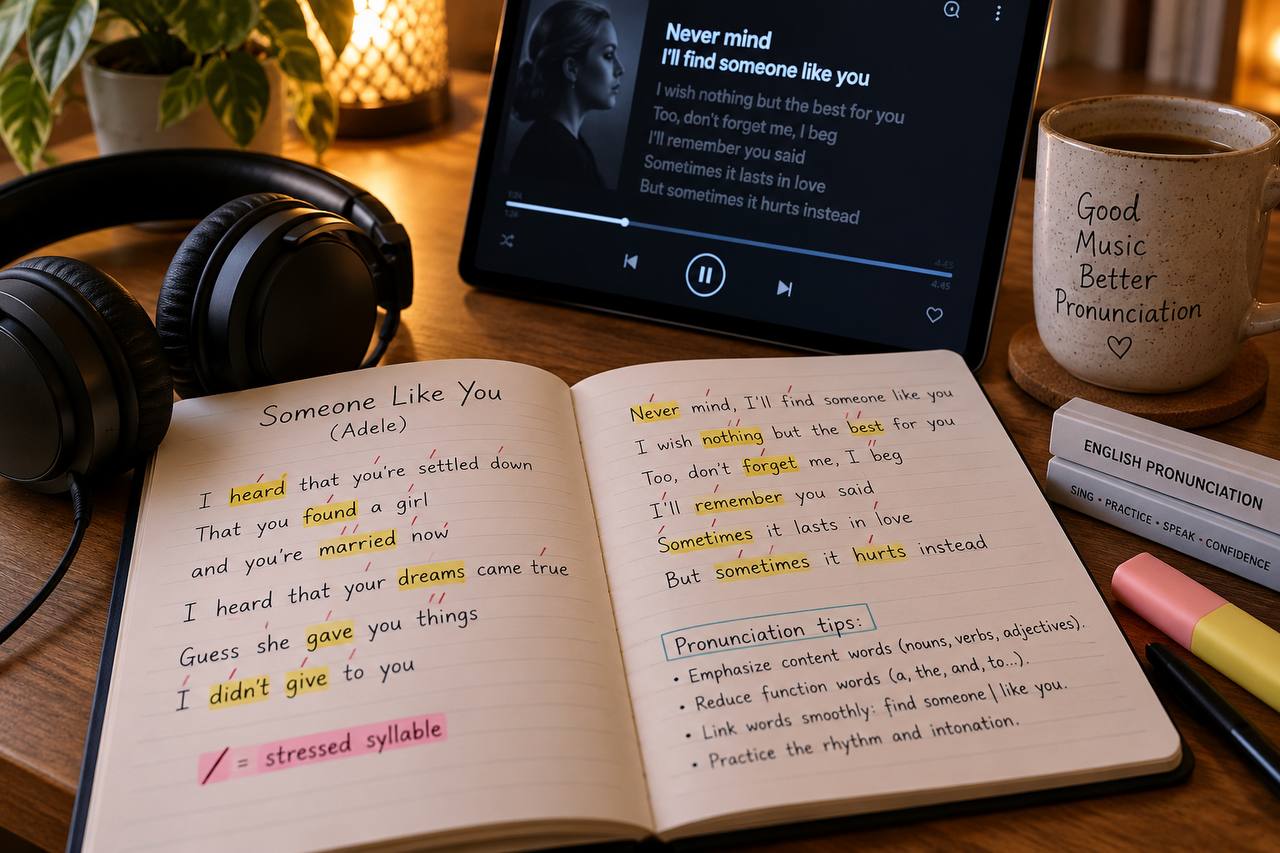
Singing requires you to link words smoothly and maintain breath control, two skills that directly translate to clearer conversational delivery.
Key Factors to Focus On During Practice Sessions
Simply playing your favorite tracks in the background will not automatically upgrade your speaking skills. Intentional practice requires active engagement with the text and the mechanics of your voice. Focus on a few core elements whenever you pick a track to study.
Choosing the Right Material for Your Skill Level
Not all genres are equally useful for pronunciation practice. Rapid hip-hop tracks with dense lyrical delivery can overwhelm even advanced speakers, while extremely slow ballads might encourage unnatural stretching of vowels. The sweet spot lies in genres with clear vocal mixing and moderate tempos.
Acoustic pop, folk, and indie tracks often feature clean vocal performances where each word is distinct yet connected. Select songs where you can easily read along with on-screen lyrics, allowing your eyes to track the text while your ears process the exact audio cues.
Building a Practical Practice Checklist
To get the most out of your musical study sessions, treat them as structured exercises rather than casual entertainment. Following a simple routine helps reinforce muscle memory without burning you out.
Frequently Asked Questions
How does singing help with spoken English pronunciation?
Music provides a fixed rhythm and intonation pattern that helps train your mouth and vocal cords to link words together naturally, mirroring conversational pacing.
What type of music is best for language practice?
Acoustic pop and folk songs are usually ideal because they feature clear vocal mixing, moderate tempos, and understandable lyrical phrasing.
Do I need to be a good singer to use this method?
No, you do not need musical talent. The goal is simply to use the rhythm and melody as a training tool for your speech muscles and breathing.
Should I read the lyrics before singing them?
Yes, reading the lyrics aloud first ensures you understand the meaning and can pronounce individual words before attempting to match them to a fast beat.