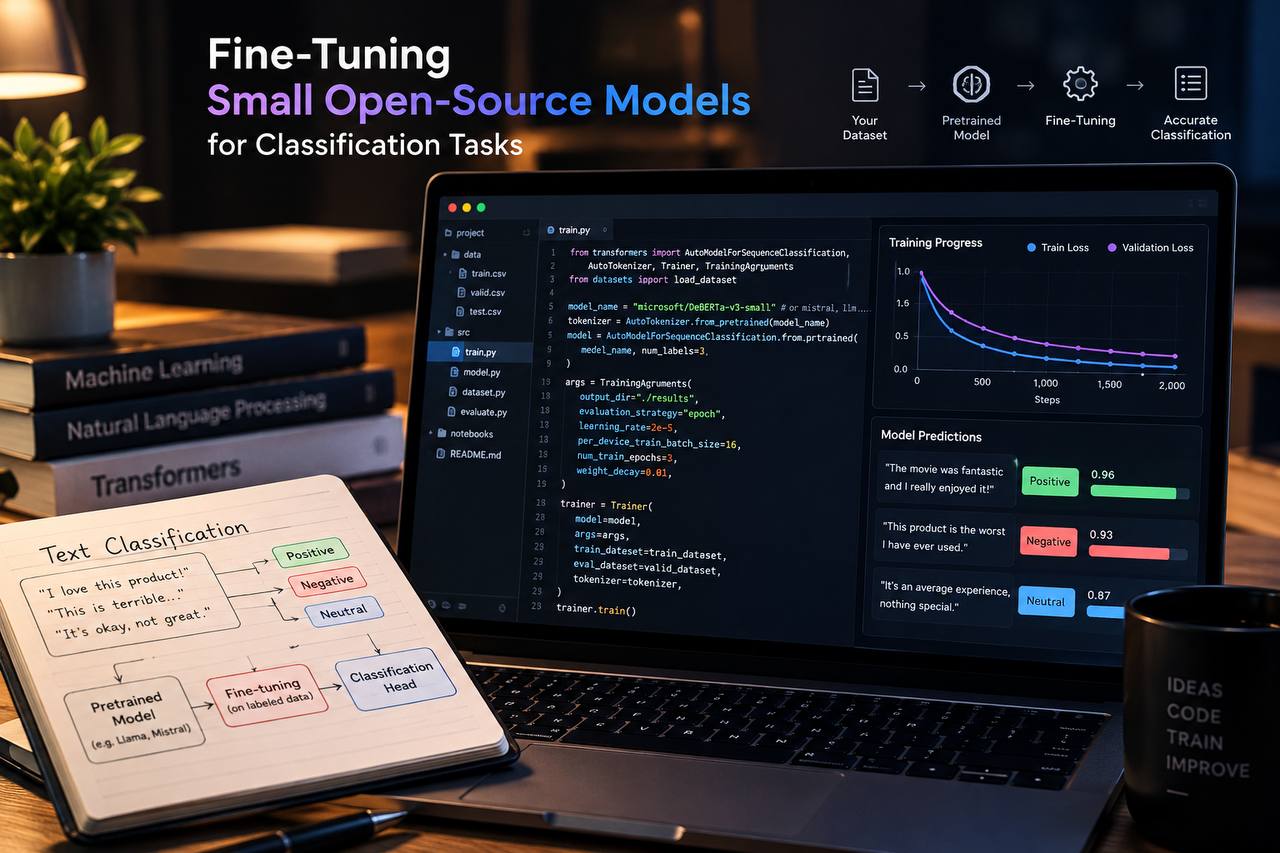
When building text categorization pipelines, relying on massive hosted APIs is not always necessary or cost-effective. Adapting compact open-source transformer models provides a local, customizable solution that runs efficiently on modest hardware while maintaining high accuracy for specific domain needs.
This guide covers the core workflow required to take a pre-trained base model and tailor it to a custom text classification task. From structuring input tokens to managing evaluation splits, careful engineering ensures that lightweight models generalize well without overfitting.
Why Lightweight Models Excel at Targeted Classification
Small transformer architectures strike a practical balance between inference speed and expressive capability. While gigantic language models offer broad general knowledge, classification tasks often require recognizing specific patterns rather than creative generation. Smaller models process requests faster, consume significantly less memory, and can be hosted locally without recurring API costs.
For many production pipelines, low latency is critical. A compact model can handle hundreds of categorization requests per second on standard GPU hardware, making it ideal for real-time applications such as spam filtering, sentiment analysis, or automated ticket routing. You can review some of our related experiments in our projects collection to see how models integrate into larger architectures.
Preparing and Formatting Training Datasets
The success of any fine-tuning run depends heavily on clean, consistent data preparation. Raw text must be tokenized using the exact vocabulary and configuration associated with the chosen base checkpoint. Label mapping also requires careful attention to ensure category integers align correctly with model output dimensions.
Selecting Key Hyperparameters for Stable Training
Training stability relies on sensible hyperparameter choices. Unlike full pre-training, fine-tuning requires a much smaller learning rate to avoid destroying the general linguistic representations already baked into the base weights. Common schedules incorporate a linear warmup followed by a gradual decay.
Batch size and gradient accumulation steps must be adjusted together based on available VRAM. Keeping batch sizes consistent helps maintain gradient estimation stability across epochs, reducing the risk of sudden loss spikes during early training stages.
A conservative learning rate paired with a proper evaluation split prevents catastrophic forgetting and yields stable classification performance.
Validation Strategies and Preventing Overfitting
Monitoring training loss alone is rarely enough to judge classification quality. Using stratified k-fold cross-validation or a dedicated held-out validation set provides a clearer picture of how well the model handles unseen examples. Tracking metrics like precision, recall, and F1-score helps identify imbalances that overall accuracy might mask.
Early stopping is a reliable safeguard against overfitting. By halting training when validation loss stops improving over a patience window, you preserve the checkpoint that offers the best generalization capability.
Deploying and Managing Exported Models
Once fine-tuning concludes, exporting the model into an optimized inference format streamlines production deployment. Tools like ONNX runtime or specialized server frameworks can reduce memory overhead and accelerate inference times further. For a broader look at how we organize development experiments and technical notes, feel free to visit our overview page.