Long before deep learning models and massive neural networks dominated computer chess, mechanical and digital pioneers relied on raw calculation. Early chess machines had no intuition, strategic memory, or human-like feel for a position. Instead, they treated the chessboard as a vast mathematical tree of possible future states.
To pick a move, these vintage systems generated thousands of potential continuations a few ply deep. By assigning numerical values to pieces and board control, the machine could simulate outcomes and select the path that maximized its mathematical advantage. Understanding this mechanical evolution reveals how far computational game theory has traveled.
The Bruteforce Search Tree Foundations
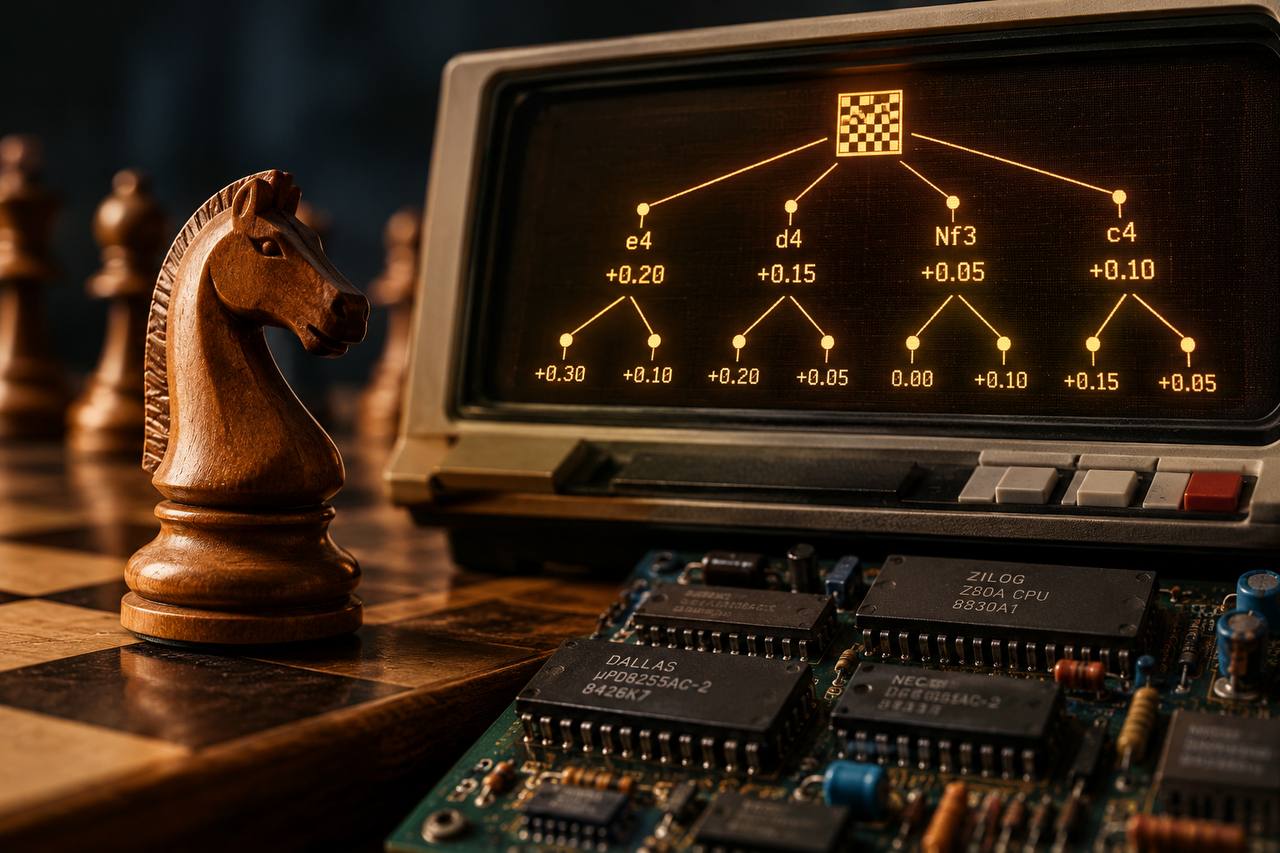
At the heart of every early digital chess machine was the concept of a state-space tree. The root node represented the current board position. Every legal move branched outward into child nodes, and opponent responses branched further still. The machine built this tree step-by-step to visualize upcoming sequences.
Evaluating Material and Position Values
Because an absolute calculation to checkmate was computationally impossible beyond a few moves, early programs relied on heuristic evaluation functions. Pawns were typically valued at one point, knights and bishops at three, rooks at five, and queens at nine. The algorithm scanned the leaf nodes of the search tree, tallied the material balance, and added basic positional modifiers like center control.
The Role of Minimax Logic
To navigate the tree efficiently, early programmers implemented minimax decision logic. The algorithm assumed that the computer, acting as the maximizing player, wanted to choose the move leading to the highest score, while the human opponent, acting as the minimizing player, would select the move minimizing that score.
Early chess algorithms treated every game as a massive game-theory exercise, balancing maximum potential gain against the opponent's best defensive response.
Hardware Bottlenecks and Processing Limits
Processing power was the ultimate constraint for vintage chess machines. Central processing units operated at speeds thousands of times slower than modern consumer hardware, with severely limited memory capacity. Engineers had to optimize every line of assembly code just to calculate three or four full moves ahead within a reasonable time limit.
Pruning the Tree with Alpha Beta Logic
As developers realized brute-force trees expanded exponentially, they introduced pruning techniques. Alpha-beta pruning allowed the program to discard entire branches of the search tree that were proven to be worse than previously examined options. This clever shortcut drastically reduced the number of evaluated nodes without sacrificing accuracy.
Transitioning Toward Modern Paradigms
While classical search trees and heuristic evaluation tables powered decades of competitive chess software, modern systems have shifted toward neural evaluation networks combined with guided search. For a broader look at how computing systems have evolved over time, you can review our main overview or explore our development projects to see experimental tech notes.