Building real-time collaborative applications requires maintaining instant data synchronization across multiple connected users. Whether users are editing text documents, moving elements on an infinite canvas, or chatting in a room, standard HTTP request-response cycles are too slow and heavy. Developers need persistent, bidirectional communication channels that push updates instantly without polling overhead.
To achieve this, engineers typically pair WebSockets with an in-memory message broker like Redis. While WebSockets maintain the open socket connections directly with individual clients, Redis provides the underlying messaging backbone that allows multiple backend server instances to communicate. You can explore more architectural patterns on my overview page to see how different components connect.
Why Standard HTTP Fails for Real-Time Workflows
Traditional web traffic relies on client-initiated HTTP requests. If a user makes a change, the browser sends a request to the server, the server processes it, and returns a response. For collaborative features, relying on HTTP polling means your app has to constantly ask the server if anything changed, creating massive network overhead and noticeable latency.
WebSockets solve this by upgrading a standard HTTP connection into a persistent, full-duplex communication channel. Once established, both the client and server can push messages at any time. This eliminates headers overhead and brings latency down to milliseconds, which is essential for smooth real-time interactions.
The Scaling Challenge with Single Server WebSocket Instances
While a single WebSocket server works well for small prototypes, real-world applications must scale horizontally across multiple container instances behind a load balancer. This introduces a critical routing problem: if User A connects to Server 1 and User B connects to Server 2, how does an action performed by User A reach User B?
Without a shared messaging layer, Server 1 has no direct way to send data to clients connected to Server 2. Each isolated server only knows about the sockets currently open on its own memory space. This isolation makes multi-instance deployments impossible unless you introduce a centralized pub-sub mechanism.
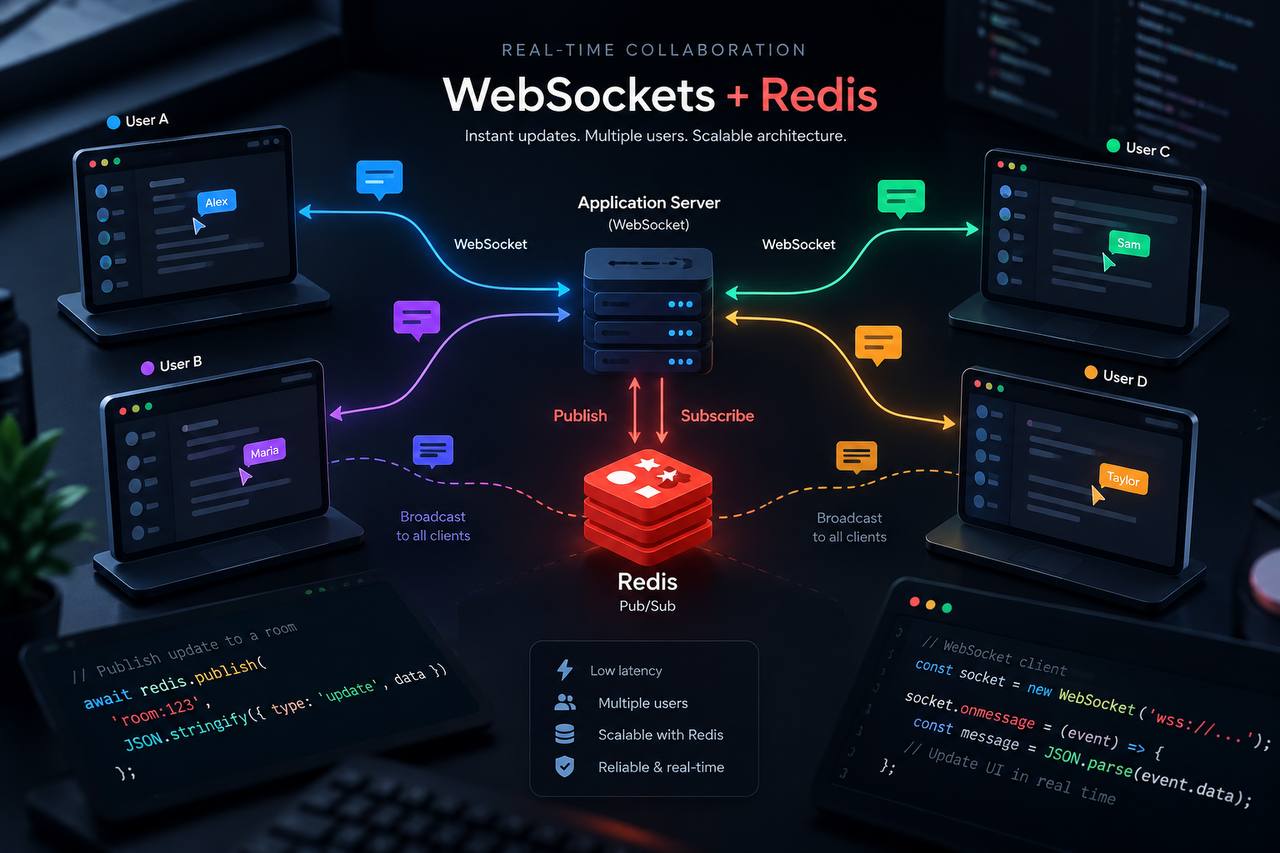
How Redis Pub-Sub Solves Cross-Server Communication
Redis provides a lightweight publish-subscribe messaging paradigm that acts as the communication bus between your isolated WebSocket server nodes. When a client sends an update to Server 1, that server publishes the message to a specific Redis channel corresponding to the active room or document.
Every other server instance in your cluster that has subscribed to that Redis channel immediately receives the payload. Upon receiving it, those servers forward the update down to any local WebSocket clients who are currently joined in that room. This decoupled architecture keeps your application stateless and horizontally scalable.
Using an in-memory broker like Redis keeps message propagation fast and decouples client socket management from cluster-wide event broadcasting.
Handling Connection Drops and Reconnection Logic
Network instability means clients will inevitably disconnect due to minor drops in Wi-Fi or mobile carrier handoffs. A robust real-time system cannot assume connections are permanent. When a client drops, the server must clean up stale socket references to prevent memory leaks and ghost connections.
Managing State Synchronization and Conflict Resolution
Broadcasting raw events is only part of the challenge; maintaining a consistent data state across all clients is equally important. If two users edit the exact same property simultaneously, naive last-write-wins strategies can overwrite critical work and frustrate users.
Depending on your use case, you may need operational transformation or conflict-free replicated data types to merge concurrent edits cleanly. Keeping your data models simple and breaking large state updates into granular, immutable patches helps reduce conflict windows.